The Blue Hour Gospel: The Blue Hour Gospel Section 3


I won’t lie; Section Three was the hardest section to choose from.
It was one of my favorite sections to write, but every time I thought about sharing a piece from it, I felt like I was giving too much away. Kind of like I was handing you the conclusions to spirals you are supposed to experience after travelling through the whole thing, start to finish. The long way around is the only way that really makes sense.
But then, sometime last night, while I was awake for what had to be the hundredth time, I had one of those annoying little aha moments that only seem to arrive when your body is begging you to sleep, and then of course keeps you awake longer because you are so excited to plan and share.
Why not share “The Quiet Between Songs”? To explain why this piece matters, I need to explain why the format matters. Because this book was never meant to be a straight line (no pun intended), queer life rarely is.
This may come as a shock to some people, but when I was growing up there was, wait for it… no social media. I know. Please take a moment of silence.
We had one family cellphone. It belonged to my dad, and we were only given it if we were going out somewhere and needed a way to call him for a ride. It called. It texted. It might have played brick breaker (if you know you know). That was it. We had one desktop computer in the basement for the whole family, and while it technically connected to the internet, it was mostly used to play games. Not online games. I’m talking about old-school, on-a-disc games. Facebook came later. Much later.
So the world I grew up in was not the world queer kids are growing up in now. Today, a gay kid can open a phone and be flooded with images of men, parties, bodies, influencers, pride, discourse, memes, thirst traps, politics, joy, cruelty, and a thousand different examples of what queer life might look like. That visibility is powerful but it’s also a lot.
Back then, though, most of us were not being offered clear mirrors. We were not finding ourselves easily in mainstream places so we had to look sideways. We were reading into things like a glance in a music video or a character who seemed different but never said why. Maybe even a lyric that felt like it had been written in code or a performer who moved through the world in a way that made something in us sit up and pay attention.
That is one of the reasons The Blue Hour Gospel uses different formats and mediums. I wanted the book itself to reflect the way many of us had to find meaning which wasn’t always in places that were built for us or made sense.
We found ourselves in the margins. In subtext. In songs. In late-night television. In fashion. In theatre kids. In villains. In divas. In the quiet ache of wanting something we had no language for yet. So this book became, in part, a way to honor that and to honor the people who made paths where none were offered.
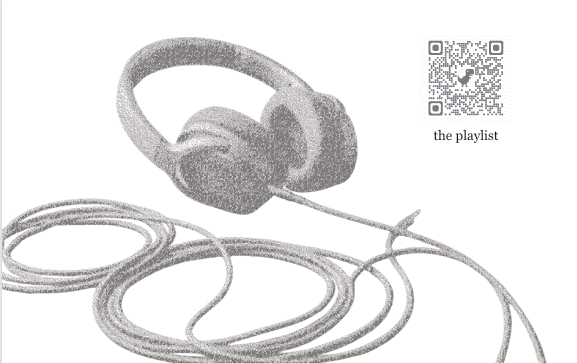
Enter, stage right: “The Quiet Between Songs.” This chapter is a QR code that brings you to a YouTube playlist. That playlist tells the entire story of The Blue Hour Gospel through music. I chose that for a few reasons.
First, because some people connect to meaning more deeply when they hear it. Even people who love reading can sometimes feel a story differently when it comes through sound. Music bypasses the careful part of the brain and goes somewhere else, somewhere we can feel it under our skin.
Second, because music, especially music videos, was one of the ways a gay kid could parse the world before the internet made everything searchable. Old music videos were full of signals. Hidden meanings, strange beauty, gender play, longing, drama. People who didn’t fit cleanly into the world around them. Sometimes you didn’t know what you were seeing exactly, but you knew you were seeing something.
For this playlist, I mirrored the book through music. Each chapter lines up with a song. Some are obvious while some are more obscure; but together they follow the emotional shape of the book. And this part matters to me most, almost every song is by a queer artist. Queer, trans, non-binary, gay, lesbian; I wanted the playlist to carry the book through voices that understood, in different ways the experience of living outside the expected script.
I wanted to ask what if we were still in that pre-social-media world? What would this story sound like to the gay kid in the late 90s watching MuchMusic, waiting for some small moment of recognition to appear on screen?
There is one song on the list by a straight artist and that choice was intentional. It marks a break in the cycle during a moment of being swept away by someone who only wanted to take. It is a beautiful song, and it fit the moment perfectly, but it also needed to feel different. When you listen to the playlist all the way through, that shift is supposed to catch you a little. It’s supposed to feel slightly wrong before you understand why. It’s where the trauma, grief, and healing begin to change shape.
So, with that said, it is my pleasure to invite you to sit back, relax, and feel The Blue Hour Gospel.
And if you stuck with it and you listened through, I am curious how it made you feel.
Were there songs that reminded you of certain parts of your own life? Songs you would pick to represent who you were at a certain age? If you grew up in the pre-Facebook era, was there a piece of music that made you feel recognized before you had the words to explain why?
One last note before I leave you to ponder.
In some ways, growing up before the social media boom was wonderful. I write a lot in the book about feeling lost, and about the strange experience of finding yourself just as the online world was beginning to open up. But I also think about the pressure of this new world. I think about what it would have meant to be young and queer with all of this visibility and comparison, all of these bodies and brands and rules about how to be desirable.
Would it have been easier to grow up seeing men loving men online? Seeing examples of gay people living openly? Maybe. Probably, in some ways. But I also think I might have drowned.
Sometimes visibility comes with a new set of cages. Body pressure. Social conformity. The constant ranking of beauty. The algorithm deciding which kinds of queer people are worth seeing and which ones disappear into the scroll, hell unless you are a celebrity memoire or a sexualized romance chances are your story won’t even be published.
Gay men are deeply affected by eating disorders and body image pressure, and I do not think that is separate from the culture we are living in. We were once told to hide and now we are often told to be visible but only if we are beautiful in the correct way. Desirable in the correct way. Marketable in the correct way. Even liberation can get repackaged and sold back to us with abs.
So yes, part of me wishes I had been able to see more of us back then. But another part of me wonders what that would have cost. Maybe that’s the work now. To break the algorithm a little and say goodbye to the old binaries of success, beauty, gender, desire, and worth. To stop letting someone else decide which stories matter because they are easy to sell.
We can rewrite them. Or maybe, more fittingly, we can hum them first. Off-key if I am talking about myself!
We owe that to ourselves. The selves we are now and the selves we were then, and the selves still coming, but until then, let the music carry us away.
Cover Design & Graphic: Brian Futter


Comments